
Go Back
Recombinant human penetrating peptide basic fibroblast growth factor (rh-TM-bFGF)
Fibroblast basic fibroblast growth factor (bFGF), also known as FGF-2, is a member of the FGF superfamily. It plays an important role in embryogenesis, tissue regeneration, wound healing, central nervous system development, angiogenesis and tumor development. bFGF is an important mitogenic factor, which has strong mitogenic activity on mesoderm-derived cells such as BALB/c 3T3 fibroblasts, capillary and endocardial cells, myoblasts, vascular smooth muscle cells, mesothelial cells, glial and astrocytes, and adrenal cortex cells. The recombinant human penetrating peptide basic fibroblast growth factor (rh-TM-bFGF) expressed in Escherichia coli is to increase the penetrating peptide before the basic fibroblast growth factor to increase its stability and expression. The recombinant protein contains 260 amino acids and has a molecular weight of 29.4 kDa.
Size:10 µg, 100 µg, 1 mg, 10mg, 100mg
Formulation: Freeze dried powder
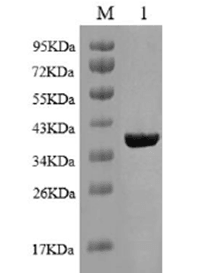
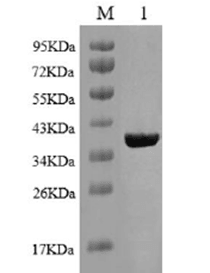
Mol. Wt.: The theoretical molecular weight is 29.4 kDa, and the SDS-PAGE run-out result is about 38KDa.
Theory pI: 7.26
Resources: Escherichia coli (E. coli)
Purity: ≥ 95%(SDS-PAGE detection)
Endotoxin: <50 EU/mg
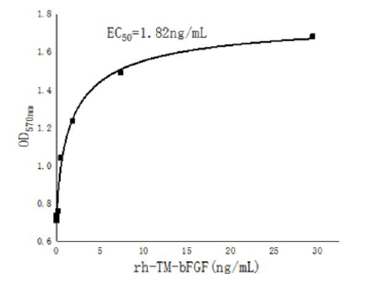
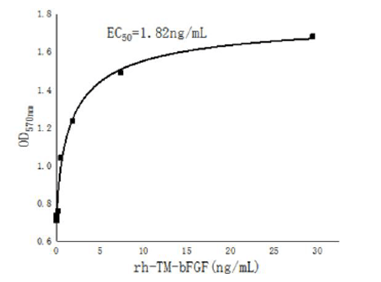
Activity: EC50= 0.5~2 ng/ml
Size:10 µg, 100 µg, 1 mg, 10mg, 100mg
Formulation: Freeze dried powder
Mol. Wt.: The theoretical molecular weight is 29.4 kDa, and the SDS-PAGE run-out result is about 38KDa.
Theory pI: 7.26
Resources: Escherichia coli (E. coli)
Purity: ≥ 95%(SDS-PAGE detection)
Endotoxin: <50 EU/mg
Activity: EC50= 0.5~2 ng/ml
More Details