Chromatography resin - Dotway Biotech -- Mfg for recombinant protein and chromatography resin
NUPhadex G-10M, 15M & 50M Size Exclusion Resin
The NUPhadex G-10 M, NUPhadex G-15 M, and NUPhadex G-50 M series size exclusion resins are epichlorohydrin-crosslinked dextran microspheres. The dry powder particle sizes of these three products are similar. After swelling, the microspheres are rigid, with decreasing crosslinking density, increasing swelling factor for the dry powder, and increasing globular protein exclusion limits in the order G-10 M < G-15 M < G-50 M.
Dextran exhibits extremely low non-specific adsorption to biomolecules. These hydrophilic, porous crosslinked dextran microspheres are primarily used for rapid buffer exchange and desalting of biomolecules in group separation processes, featuring minimal sample dilution, high desalting efficiency, and high recovery. Relatively large biomolecules have short retention times in the resin, while salts and other small molecules in the buffer are retained longer. Molecules of different sizes are separated based on their differing residence times in the resin, making this product series suitable for various biomolecular samples such as proteins, polysaccharides, and nucleic acids.
NUPhadex G-75M, 100M, 150M and 200M Size Exclusion Resin
The NUPhadex series size exclusion resins are epichlorohydrin-crosslinked dextran microspheres. Dextran exhibits extremely low non-specific adsorption to biomolecules.
These hydrophilic, porous crosslinked dextran microspheres are primarily used for rapid buffer exchange and desalting of biomolecules in group separation processes, featuring minimal sample dilution, high desalting efficiency, and high recovery. Relatively large biomolecules have short retention times in the resin, while salts and other small molecules
in the buffer are retained longer. Molecules of different sizes are separated based on their differing residence times in the resin, making this product suitable for various biomolecular samples such as proteins, polysaccharides, and nucleic acids. The globular protein exclusion limits increase progressively for NUPhadex G-75 M, NUPhadex G-100 M, NUPhadex G-150 M, and NUPhadex G-200 M. These four products are not rigid microspheres; the column bed is compressible and they are typically used with gravity flow.
NUPhadex G-25 Size Exclusion Resin
The NUPhadex G-25 series size exclusion resins are epichlorohydrin-crosslinked dextran microspheres. Dextran exhibits extremely low non-specific adsorption to biomolecules. These hydrophilic, porous crosslinked dextran microspheres are primarily used for rapid buffer exchange and desalting of biomolecules in group separation processes, featuring minimal sample dilution, high desalting efficiency, and high recovery.
These products have an exclusion limit of approximately 5000 Da for globular proteins. Relatively large biomolecules have short retention times in the resin, while salts and other small molecules in the buffer are retained longer. Molecules of different sizes are separated based on their differing residence times in the resin, making this product suitable for various biomolecular samples such as proteins, polysaccharides, and nucleic acids. It can also be used for fractionation processes to separate and purify biomolecules with small molecular weight differences, such as peptides, oligonucleotides, antibiotics, and natural products.
Co-NTA Metal Chelate Affinity Resin
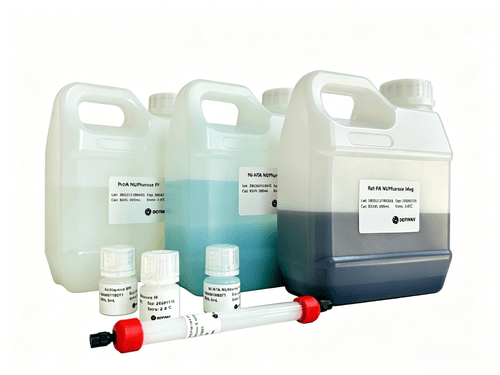
Co-NTA NUPharose FF is a metal chelate resin containing nitrilotriacetic acid (NTA) groups, primarily used for the affinity chromatography of His-tagged proteins. This product is based on our classic NUPharose agarose gel microspheres, pre-chelated with Co2+ from IMAC NUPharose FF , and is ready for direct use by the user. Different metal ions have varying affinity and specificity for target proteins: the affinity of Cu2+, Ni2+, Zn2+, and Co2+ decreases sequentially (affecting yield), while specificity increases sequentially (affecting purity). This product, chelated with Co2+, can be considered when Ni2 +-chelated resins fail to meet purity requirements.
Compared to iminodiacetic acid (IDA) ligands, NTA ligands offer more balanced performance, better tolerance to chelating agents, reducing agents, alkali, etc., and exhibit lower metal ion leaching during the purification process.
r-Protein A Affinity Resin
The rProtein A ligand is expressed in E. coli, ensuring that it is free from animal-derived components while retaining all five binding domains of the wild-type protein.
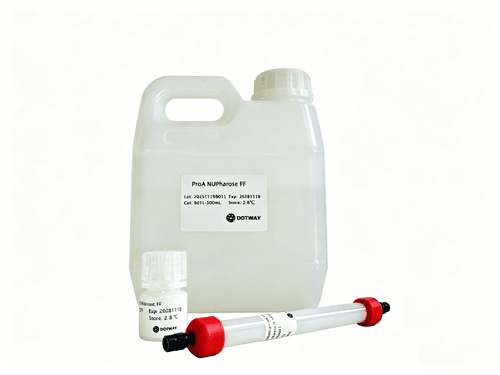
ProA NUPharose FF exhibits significantly higher binding capacity compared to wild-type Protein A resins, with a dynamic binding capacity for human IgG exceeding 40 mg/mL.
This resin demonstrates affinity towards various types and subtypes of antibodies from multiple species, including human, mouse, rat, rabbit, and bovine sources.
It is capable of isolating and purifying different subclasses of mammalian antibodies or genetically engineered recombinant proteins containing Fc fragments from ascites, serum, cell culture supernatants, or cell lysates, thereby meeting research and production requirements at various scales.
Cookie Use
We use cookies to ensure a smooth browsing experience. By continuing we assume you accept the use of cookies.
Learn More